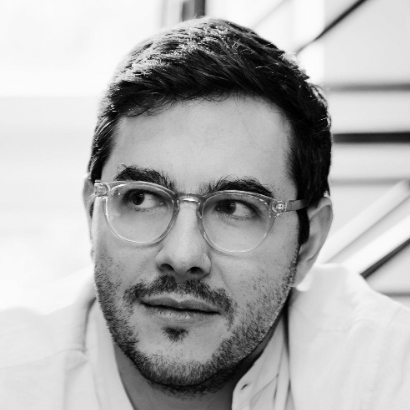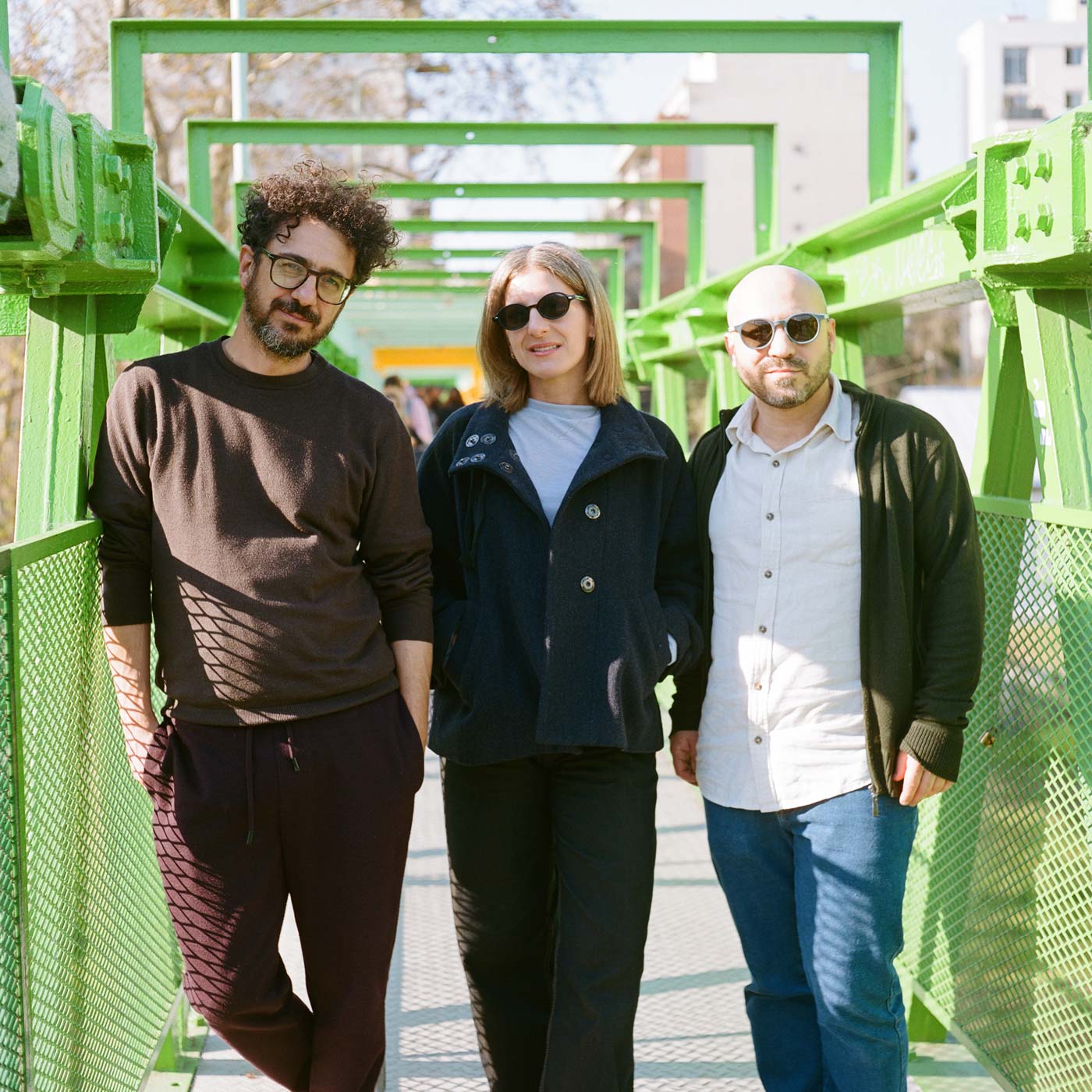
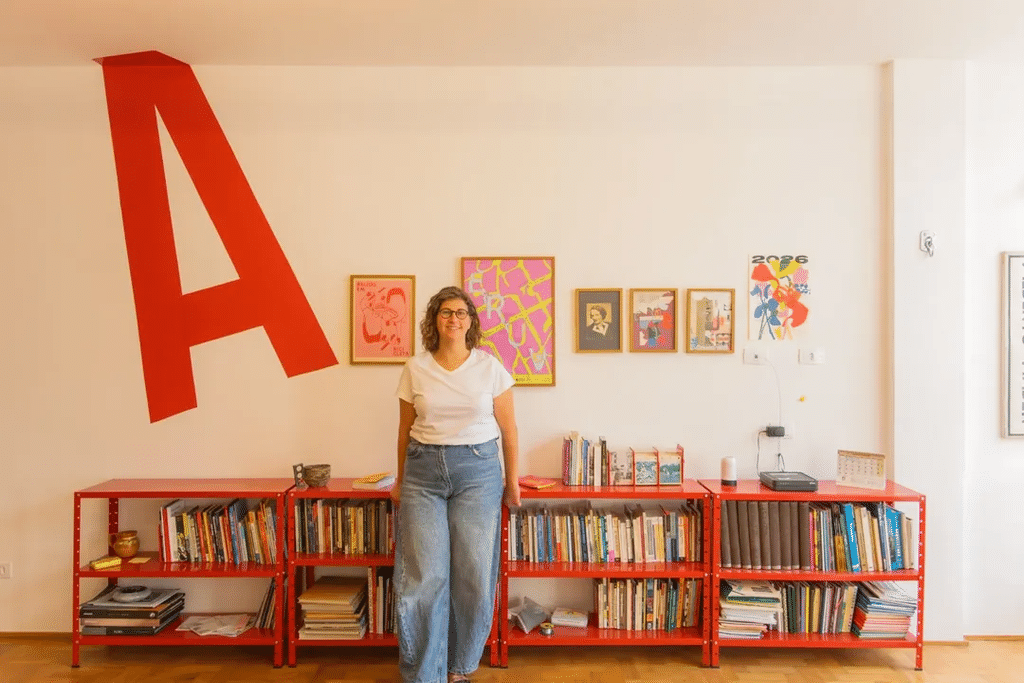
This piece by Alan Grabinsky was originally published in English in the autumn 2026 issue of Jewish Renaissance, a British magazine dedicated to Jewish culture and arts. The magazine is available exclusively in print, though this article can also be read as a PDF on their website. We are republishing it here, in translation and with the magazine’s permission. We would like to thank Jewish Renaissance and its editor, Rebecca Taylor, for their generosity; Alan Grabinsky for the text; artists Sara Camhaji and Elián Stolarsky, along with curator Tamara Crespin, for sharing their stories; and photographer Gabriela Gleizer for the portraits.
On 6 October 2023, the Argentinian artist Agustín Jais opened an exhibition of his work at his studio in Jerusalem1. The next morning, after a brief return to the studio, he left quickly and in disorder; brushes uncleaned, canvases half-finished. He has not returned since. Jais had spent four years in Jerusalem working as a curator and an artist. He was a member of ArtCube Artists’ Studios, a collective based in the centre of the city, and had finally found the space to develop a more “personal practice”. When news came of the Hamas attacks on 7 October, the decision to leave the country was swift and, he admits, naive. “We thought we’d go to my brother’s place in Barcelona, see what happened, and go back,” he told me. “We didn’t go back.”
He went to Buenos Aires. It was there, in the city where he had grown up, that Jais began to understand what he had to do.
Breaking out of the bubble
In Argentina, he encountered artists in crisis. People who had spent careers navigating between their Jewish identity and their professional lives suddenly found themselves alone, their work politicised overnight by a war they had no part in and their projects cancelled. But he also found something he hadn’t expected: artists who told him they needed to make something.
“After 7 October I kept running into people who said: ‘I need to do something with this [7 October].” That double reality — more urgency to create, less ground to stand on
— became the founding tension of what he was about to build.
In 2024, Jais, along with Maia Minovich (whom he had known since his days in Netzer Argentina, the Reform Zionist youth movement) established Arte Judío Latinoamericano, or AJLA, a network, digital media outlet and research organisation dedicated to supporting Jewish artists and cultural workers from Latin America and promoting contemporary art and culture from the region. It is the only organisation of its kind. In Arabic, ajla means ‘sweet’; in colloquial Hebrew, it’s slang for ‘excellent’ or ‘cool’.
The idea began forming in Israel, where Jais encountered a world of Jewish artistic infrastructure — networks, residencies, institutions — that simply did not exist south of the Rio Grande. “Someone should activate this in Latin America,” he remembers thinking. Once in Buenos Aires, he concluded that the someone would have to be him.
Another member of the core team, who has been involved in AJLA from the start, is the journalist and screenwriter Exequiel Siddig. He had spent 20 years in Argentine media, most recently writing for A Big Shtetl, a television series about the Jewish traces of Buenos Aires.
“In Argentina, AJLA is the only cool place where you can think about Jewish life from an artistic and intellectual perspective,” says Siddig, now AJLA’s editor-in-chief. “It tries to break out of the bubble of internal community consumption. It’s a Judaism for the world.” He has affection for the Jewish left–wing magazine Nueva Sion, but says that Argentina’s existing Jewish media is largely directed inward. “It talks to the community. We’re interested in finding something Jewish in the work, and we investigate it from there,” says Siddig, who oversees all the organisation’s published material.
An artistic desert
In 2025, AJLA released the first systematic survey of the Latin American Jewish arts ecosystem, eliciting responses from 402 artists and cultural workers from across Argentina, Brazil, Mexico and Uruguay. The first survey of its kind, its findings are uncomfortable in ways that go beyond the well–documented rise in antisemitism.
Half of those who responded had collaborated professionally with Jewish institutions, which showcased their art or performances. But these contributions were mostly voluntary. There are no professional networks or bodies dedicated to supporting or funding them. AJLA itself has struggled to find funding and most of its team are volunteers.
In addition, since 7 October 52 percent of respondents reported experiencing antisemitism directly in cultural spaces, while 44 percent said their interest in expressing their Jewish identity had grown during that same period. Yet most of them have no outlet through which to pursue it.
“It’s a desert,” says Jais. “There are little islands of support, but there is no concerted effort to create Jewish culture across the region.” When he read through the responses, two expressions kept recurring: ‘thank you’, and ‘loneliness’.
When the results of the survey were presented, to a packed auditorium in Buenos Aires, there was a striking response from many of the traditional Jewish institutions in attendance. “It opened their eyes to how isolated Jewish creatives were feeling,” says Jais, who hopes that this new awareness will lead to closer collaboration. “We’d like to work with institutions across Latin America to create opportunities for artists to make new work, exhibit it and reach new audiences,” he says.
Twenty–seven–year–old architect and urban researcher Tamara Crespin lives in the Brazilian capital, São Paulo. She grew up in a fully Jewish world. She attended Jewish school, Bnei Akiva and the Hebraica club, until architecture school opened her up to a different relationship between identity and the city.
During the pandemic, alone at home, she began connecting her Jewish identity with her studies, making collages about the diaspora and researching the position of the eruv (an area within which observant Jews can carry, or push, objects on Shabbat) in the context of urban planning.
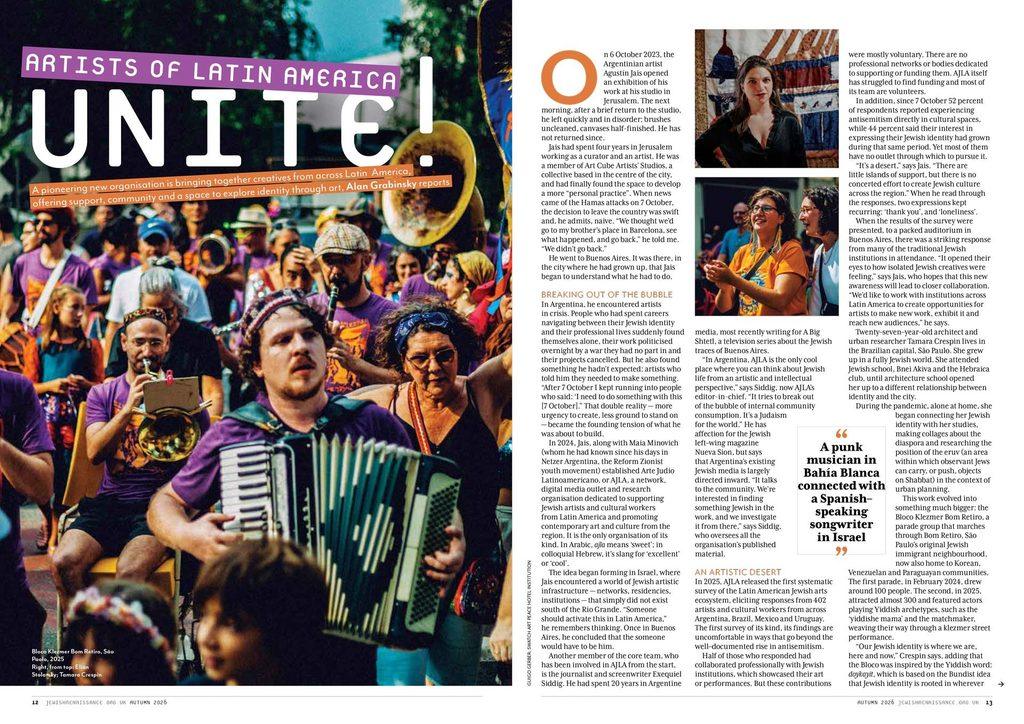
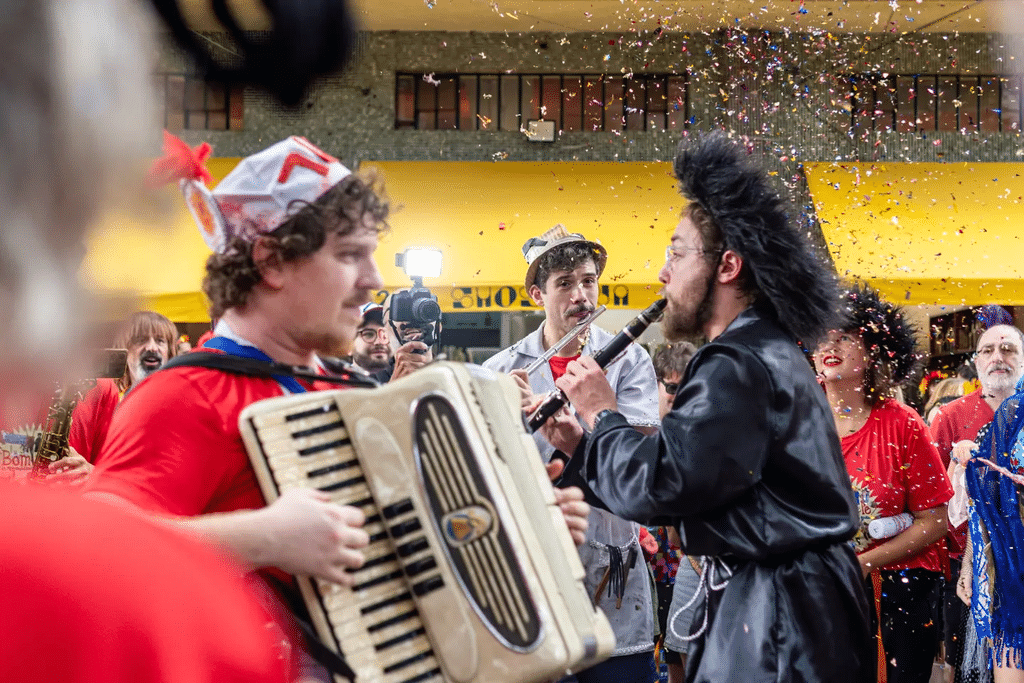
This work evolved into something much bigger: the Bloco Klezmer Bom Retiro, a parade group that marches through Bom Retiro, São Paulo’s original Jewish immigrant neighbourhood, now also home to Korean, Venezuelan and Paraguayan communities.
The first parade, in February 2024, drew around 100 people. The second, in 2025, attracted almost 300 and featured actors playing Yiddish archetypes, such as the ‘yiddishe mama’ and the matchmaker, weaving their way through a klezmer street performance.
“Our Jewish identity is where we are, here and now,” Crespin says, adding that the Bloco was inspired by the Yiddish word: doykayit, which is based on the Bundist idea that Jewish identity is rooted in wherever Jews actually live: not in Israel, or the shtetl, but in this city, on this street.
Now, together with AJLA, she hosts a regular virtual meeting space, MESA, that brings together creatives from across Latin America to learn from each other about different artistic practices and to discuss future projects or challenges. The sessions are held in Portuñol, an improvised mix of Portuguese and Spanish.
The meetings have led to some surprising connections: a punk musician in the Buenos Aires seaport of Bahía Blanca connected with a Spanish–speaking songwriter in Israel, leading to them writing songs together. An artist from Manaus, in Brazil’s Amazon region, shared the history of the first Jews of the Amazon. A Venezuelan living in Guayaquil, Ecuador, described his experience of living in a remote part of the diaspora.
“A punk musician in Bahía Blanca connected with a Spanish– speaking songwriter in Israel”.
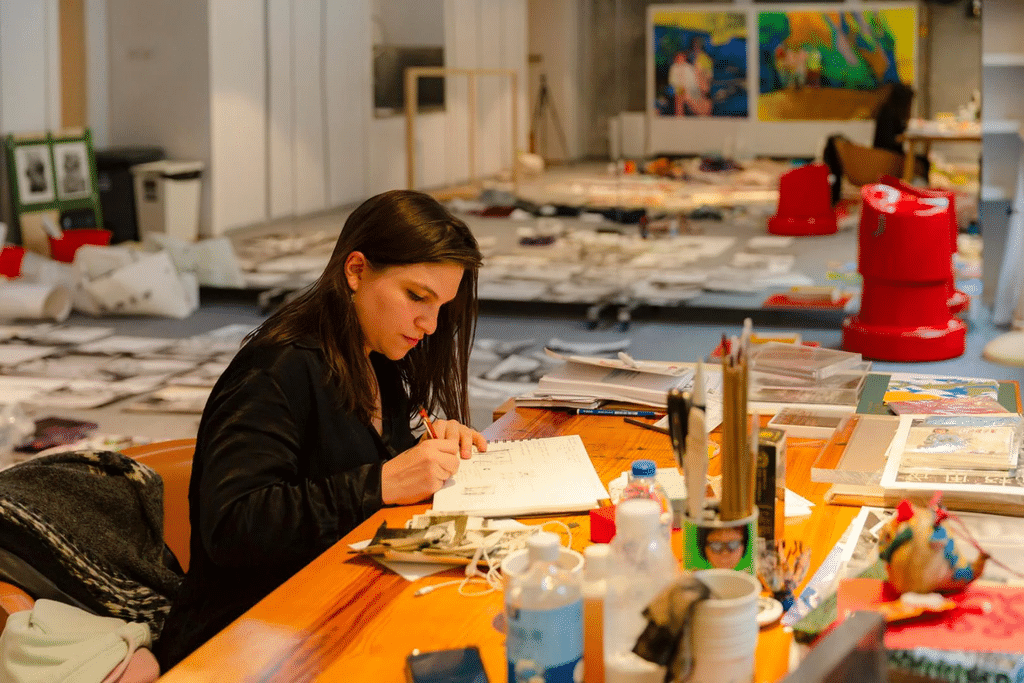
‘It isn’t eurocentric’
For Uruguayan artist Elián Stolarsky, AJLA has become an important support network. She grew up in Montevideo, did a master’s at the Royal Academy of Fine Arts in Ghent, Belgium, and is currently finishing a doctorate in Madrid. She says her work has always been a form of “symbolic digestion”, a third–generation processing of traumas she didn’t live. At the outbreak of World War II, her Polish grandparents were very young; by the time she was born, any references to the Holocaust had been replaced by silences, gestures and inherited terrors she couldn’t name. In her work, which mixes textiles with collages and paint, she unpicks this heritage by drawing on symbols from the Kabbalah (a tradition of Jewish mysticism).
Since 7 October she has been marking Shabbat more frequently and feels motivated to build a Jewish community around her in Madrid, because she is conscious that sometimes people slipped into antisemitic language without realising the impact of what they were saying.
“In my professional life I’ve always been afraid,” she says. “Even when the art I create comes from a Jewish sensibility, I avoid mentioning that part of it when I talk about my work because of fear of how I will be received – and fear about funding. I can’t prove it, but if I explicitly mention my work is Jewish, my chances of getting grants probably fall even lower.”
For Stolarsky, AJLA is a place where Latin American Jewish art can emerge without first being assessed through a European filter. “AJLA was the first place I’d come across that gave visibility to art created within the framework of Judaism and Latin America. It isn’t eurocentric.”
“Finding other outsiders is very nourishing”.
Sara Camhaji is a Mexican poet, writer and performer who met Jais and discovered AJLA through Asylum Arts, a global network of over 700 Jewish and Israeli artists. “As an artist with Jewish content, there’s always a feeling that your work must be moral or didactic. For me, art doesn’t have that objective. The possibility of being an artist working with Jewish materials without that religious, social, pedagogical responsibility is refreshing.
“Jewish identity asks you for a loyalty to something, a political position,” which drives many artists from claiming it at all, even when it runs through everything they make, says Camhaji. One of her recent performances was a butoh piece, a form of avant-garde dance, for one of Mexico City’s Jewish festivals. The work, Adama BeEynaim (Hebrew for Earth in the Eyes), is about the tradition of the firstborn placing soil on a parent’s eyelids at death. “A bit dark, as you might imagine,” she says, laughing. For her, AJLA is a place where Jewish artists can be outsiders together. “Finding other outsiders is very nourishing,” she says.
Jais’s vision for AJLA is ambitious: an itinerant biennial of Latin American Jewish art that crosses borders. The challenge, he says, is to weave together the local scenes, the individuals working in isolation across huge distances, into something powerful. “There is an enormous amount of talent in Latin America and a freedom to create and produce it, even in the context of antisemitism. That is very special, very unique right now.”
Cover photo: AJLA founders: (left to right) Exequiel Siddig, Maia Minovich and Agustin Jais in Buenos Aires, September 2026. Photo: Gabriela Gleizer
- Note: The exhibition took place at the Kol HaOt gallery in Jerusalem. At ArtCube Artists’ Studios, Jais was an artist-in-residence and developed initiatives as a curator and cultural producer. ↩︎